
Your First Impression Starts Before You Say a Word
Sep 18, 2026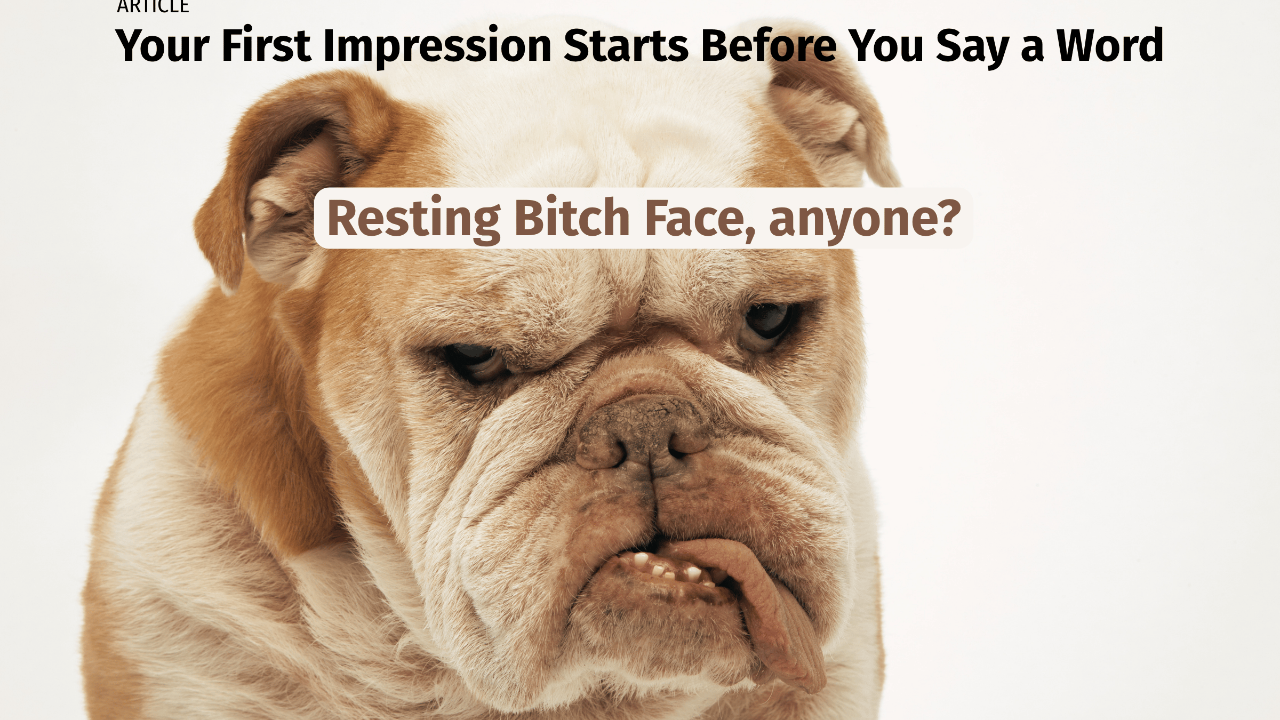
I had always assumed a first impression started when we began speaking.
“Hi, I’m Ash.”
What I recently discovered is that by the time you open your mouth to speak, you are already well into the first impression.
Research says impressions of unfamiliar faces happen lightning quick. In one well-known study, people made judgements about things like trustworthiness, competence and likeability after seeing a face for just 100 milliseconds.
A tenth of a second. Lightning.
You haven’t even introduced yourself, let alone had time to say anything funny or clever. There’s been no opportunity to demonstrate that you’re kind, or competent, or interesting, or actually quite lovely once people get to know you.
They’ve seen you and begun forming an impression almost instantly.
Before the conversation begins
I’ve been listening to Vanessa Van Edwards recently, who refers to herself as a “recovering awkward person”, which I find personally very relatable. Vanessa is a well-known behavioural researcher and has spent much of her adult life studying how people communicate.
One of the things she talks about is the cues we constantly give other people.
Some cues signal warmth. Can I trust you?
Other cues signal competence. Can I rely on you?
And apparently, we are signalling these (or not) long before we consciously start trying to communicate anything at all.
Imagine yourself walking into a room where you don’t know anyone.
Before you speak, people are already taking you in. What you’re wearing. How you’re standing. Whether your shoulders are hunched or relaxed. Whether you’re looking around the room or down at your phone. Whether your face appears open and interested or like you’d rather be anywhere else.
All of these things are giving them information, and they’re already using that information to form an impression of you.
The point isn’t to construct some universally appealing version of yourself. It’s to become more aware of what you’re communicating, intentionally or otherwise.
So perhaps the better question is:
Does the way I’m showing up match the way I actually want to show up?
Unfortunately, your face is involved
Van Edwards talks about her own face and having a naturally downturned mouth. Which means if she isn’t consciously doing anything with her face, she can look less approachable than she intends.
So before entering a room, including a virtual one, she consciously engages the muscles around the sides of her mouth.
She isn’t plastering on a fake smile, but making a small adjustment to make sure she isn’t signalling something she doesn’t mean.
Which brings us inevitably to resting bitch face.
Some of us just have faces that, when left unattended, appear deeply unimpressed with the world.
That may not be what’s happening in our heads, but the other person doesn’t have access to our heads. They have access to our face.
Van Edwards was once asked whether constantly having to think about correcting her expression was exhausting.
Her response was essentially: choose your hard.
Yes, making the effort is work.
But so is dealing with the consequences of being repeatedly thought of in a way that doesn’t reflect who you are.
You can resent the fact that people make rapid judgements based on your face, posture, clothing and body language. You can decide they shouldn’t.
And you’d have a point.
They’re going to do it anyway.
So choose your hard.
There’s a difference between contorting yourself to please other people and understanding the signals you’re sending.
If I’m genuinely pleased to meet you, but my face is signalling I would like you to go away, I’d rather know.
You’re not trying to fool anyone
There is something about conversations around body language and first impressions that can quickly start to feel manipulative.
Handshakes should be firm and dry. Stand like this. Smile like that. Make people like you. Shoot me now please.
If I’m pleased to be somewhere, I want the person meeting me to see that.
If I’m interested in them, I’d like my attention to communicate that.
And if I’m nervous?
Well, I can be nervous.
Being aware of the signals I’m sending doesn’t mean manufacturing a different person. It means giving the person I actually am a better chance of being seen.
Beginnings happen all the time
I’ve been thinking a lot about beginnings lately, and a first impression could be the beginning of something really good.
A new colleague.
A new neighbour.
A new friend.
A new connection.
We don’t know, when we first meet someone, what role that person might eventually play in our lives. Most encounters will probably remain just that. But occasionally, someone who was a complete stranger five minutes ago becomes important to us.
Connection is integral to being human. And perhaps that makes these small beginnings worth paying attention to.
So next time you’re about to walk into a room, particularly one containing people you haven’t met before, take a moment to reset before you cross the threshold.
Shake off where you’ve just been.
Breathe.
Check in with yourself.
Check in with your face.
Then walk in.
We can’t control the impression another person forms of us, but we can pay attention to what we’re giving them to work with.
Worth exploring
This article was inspired in part by the work of behavioural researcher Vanessa Van Edwards, who is one of my personal heroes. I’ve been following Vanessa for a number of years now and find her work on human behaviour, communication and connection endlessly fascinating.
You can find more of Vanessa’s work at Science of People, or in her books Cues and Captivate.
Join me each month.
Better habits. Better decisions. Better conversations.
Join my monthly newsletter for thoughtful observations, practical ideas and honest reflections to help you live more intentionally.
No noise. No algorithms. Just something worth reading. We respect your privacy. Unsubscribe at any time.